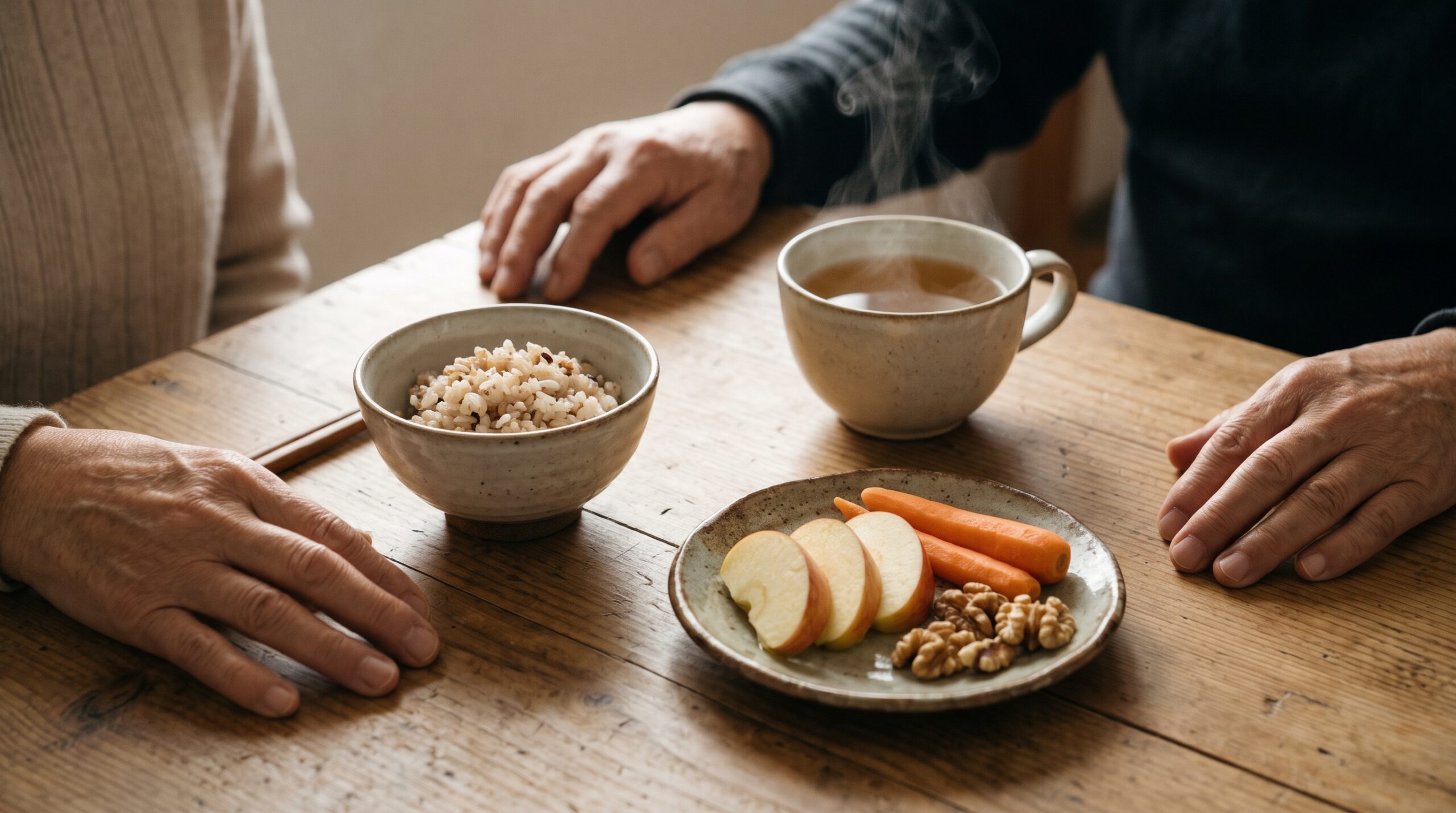
The Loving Tug-of-War at the Senior Table: Why Less is More After 65
- Meta Description: A loving dining table tug-of-war between eating more for strength and eating less for lightness reveals the ultimate digestive wisdom after 65.
- Category: Sustainable Eating
- Tags: Light Eating, Digestive Health
Quick Summary
- Gentle Volume Reduction: Aging digestive organs struggle with heavy loads; stopping at 70–80% fullness spares critical cellular energy for healing rather than non-stop digestion.
- Quality over Quantity: Honor wholesome nutrition—fresh raw vegetables, clean proteins, and healthy fats—while consciously reducing excess refined carbohydrates.
- A Frictionless Micro-Habit: Taking three deep breaths before eating and scooping out one-third of your rice bowl creates instant digestive relief and prevents post-meal fatigue.
Introduction
Every evening, a quiet, gentle tug-of-war takes place across our small dining table.
My wife carefully heaps extra side dishes onto my bowl and insists, “You must eat well to keep your vitality up as the years go by. Get enough protein, finish your rice, and protect your immune system. How can you stay strong eating so little?”
I understand the warmth and genuine care behind her words. Yet, before my bowl is even half-empty, a quiet instinct tells me to set down my chopsticks.
“My dear, when we pass 65, an empty stomach brings a clear body. Overeating forces all our vitality into digestion, leaving us sluggish and heavy.”
Her belief that robust meals maintain endurance meets my conviction that gentle restraint preserves vitality. Both perspectives spring from the very same desire: to live soundly, comfortably, and gracefully together for many years to come.
1. The Root Benefit: Why Fullness Feels Heavier After 65
In our thirties and forties, a large, hearty meal acted like coal shoveled into an roaring furnace. We burned through everything effortlessly, converting heavy portions directly into next morning’s stamina.
After 65, that internal furnace operates on a completely different biological rhythm. Stomach acid secretion declines, digestive enzymes diminish, and gut motility slows down. An ancient proverb captures this shift with precision:
“Fill the stomach to seventy percent, and you need no doctor. Fill it to one hundred percent, and even the finest physician cannot save you.”
When we overstuff an aging stomach, a massive volume of blood rushes to the gastrointestinal tract to process the backlog, leaving the brain and extremities oxygen-deprived. That overwhelming afternoon drowsiness—where the body feels like waterlogged cotton—is not simple fatigue; it is a metabolic distress signal.
Furthermore, our immune system and cellular repair mechanisms cannot attend to systemic inflammation while all bodily energy remains hijacked by round-the-clock digestion. Leaving a margin of emptiness is the only way our internal organs can breathe and heal.
2. The Micro Habit: Merging Love and Lightness
Does this mean a senior should turn to harsh restriction or skimpy fasting? Absolutely not.
Under-eating without nutrient density causes older adults to shed vital muscle mass and bone density, leading to sudden frailty. My wife’s intuition is irreplaceable: our bodies require prime building blocks every single day.
The secret lies in harmonizing the two perspectives: Eat rich in quality, but moderate in volume.
- Keep the Quality (The Wife’s Gift): Savor nutrient-dense components—steamed greens, crisp raw carrots, clean fish or tofu, and a sprinkle of walnuts.
- Trim the Volume (The Husband’s Wisdom): Quietly cut back on starchy staples, refined rice, and heavy sauces.
- The 70% Plate Rule: Do not wait until your belt feels tight. Stop when you think, “I could eat a few more bites, but I feel pleasantly comfortable.” That gentle margin transforms meals from an exhausting metabolic burden into pure, clean energy.
3. Doing One Thing Different: The “One-Third Scooped” Method
Transforming how we eat does not require complicated scales or calorie counting apps. It begins with one effortless micro-habit:
- Scoop Out One-Third First: Before your first bite, spoon one-third of the starch out of your bowl and set it aside. Doing this before you start eliminates decision fatigue mid-meal.
- Take One Deep Diaphragmatic Breath: Before touching your cutlery, pause for a slow 4-second inhale and 8-second exhale. This switches your autonomic nervous system from sympathetic fight-or-flight into parasympathetic rest-and-digest, priming stomach acids naturally.
- Chew 30 Times: Thorough mastication coats food with saliva enzymes, taking half the physical breakdown workload off your stomach lining.
Frequently Asked Questions (FAQ)
Q1. Will eating smaller portions cause muscle loss or low energy? A: True light eating is not starvation. When you reduce bulky, empty carbohydrates while prioritizing quality plant proteins, raw vegetables, and healthy fats, your body preserves lean muscle mass while eliminating chronic inflammatory fatigue.
Q2. Why do I feel so drowsy right after lunch? A: Overfilling your stomach forces an enormous surge of blood away from the brain and into the digestive organs. By keeping your portion to roughly 70% fullness, blood glucose stabilizes smoothly, and post-meal lethargy disappears almost immediately.
Conclusion
As the years accumulate, living well is less about grasping more and more, and increasingly about letting go of what burdens us.
Tonight, receive the warm nourishment placed before you with gratitude, chew slowly, and leave a quiet margin of lightness in your stomach. Give your organs the breathing room they have earned over six decades, and welcome a peaceful, energetic evening.
Evidence & References
- Dr. Robert H. Lustig, Metabolical (2021): Emphasizes protecting the liver and feeding the gut microbiome through whole foods while reducing metabolic overload caused by refined carbohydrates and excessive caloric density.
- Okinawan Longevity Philosophy (Hara Hachi Bu): The cultural practice of deliberately stopping eating when 80% full, documented in the Okinawa Centenarian Study as a primary driver of metabolic flexibility and healthy vascular aging.
- American Gastroenterological Association (AGA): Clinical reviews noting the age-related decline in gastric motility, resting mucosal blood flow, and pancreatic enzyme production in adults over 65, recommending smaller, nutrient-dense meal patterns.